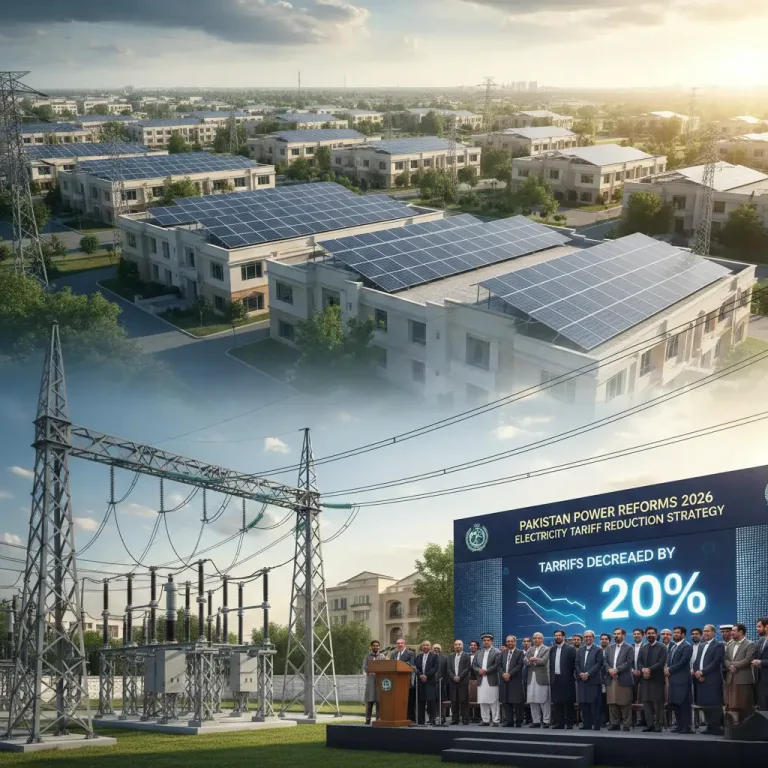
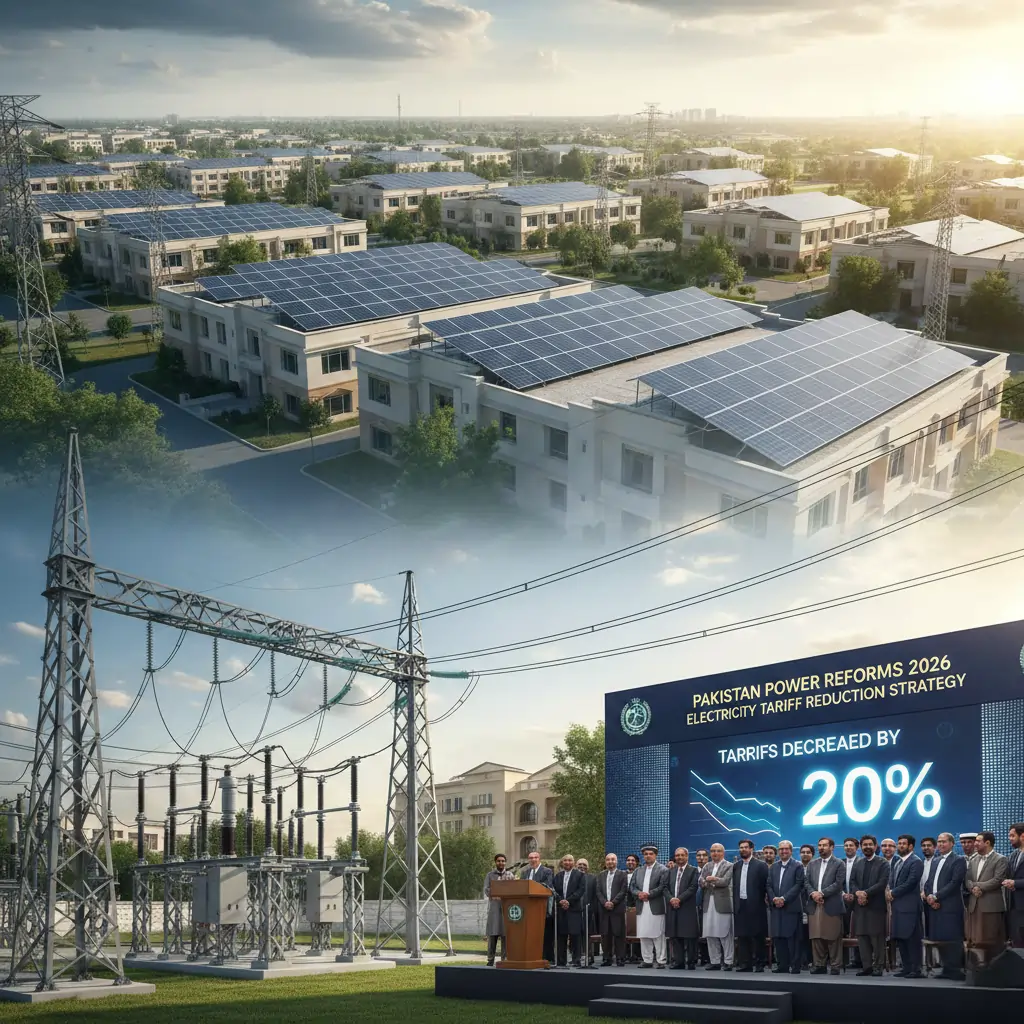
Government announces power sector debt restructuring plan to cut electricity tariffs as solar adoption rises across Pakistan
Pakistan Power Sector Debt Restructuring & Solar Challenge 2026. Complete Analysis
Pakistan’s power sector is undergoing a major transformation. While launching the Prime Minister’s Fan Replacement Programme in Islamabad, Power Minister Sardar Awais Leghari announced that the government is considering large-scale energy sector debt restructuring to reduce electricity tariffs and address rising circular debt.
At the same time, rapid solar adoption across households has created a new operational challenge for the national grid.
Why Pakistan Is Restructuring Power Sector Debt
Pakistan’s power sector is burdened with:
-
Circular debt: Rs1.6 trillion
-
Recent commercial bank financing: Rs1.225 trillion
-
Chinese power sector debt: Approximately $30 billion
-
Ongoing negotiations with global lenders like the World Bank and the Asian Development Bank
What Is the Plan?
The government is exploring:
-
Refinancing short-term expensive loans
-
Converting debt into 15–20 year concessional multilateral financing
-
Lowering the cost of servicing power sector debt
-
Reducing consumer-end electricity tariffs
Expected Impact on Electricity Prices
Officials estimate that restructuring could reduce industrial tariffs from:
-
Current: 11.5 cents per unit
-
Target: 8–9 cents per unit
This move aims to make Pakistan’s industry internationally competitive and revive manufacturing growth.
Solar Boom: A Blessing and a Grid Challenge
Pakistan has witnessed a “people-led solar revolution.”
Key Statistics (FY2025–2035 Projections)
-
Clean energy share in national generation: 55% in FY2025
-
Expected to cross 90% by 2035
-
Daytime demand dips to: 8,000 MW
-
Peak demand exceeds: 26,000 MW
The Core Issue
As more households install rooftop solar systems:
-
Daytime grid demand falls sharply
-
Power plants must remain on standby for evening peaks
-
Fixed capacity payments continue
-
Cost burden shifts to non-solar consumers
Minister Leghari acknowledged that pricing imbalance needs rationalisation to prevent unfair cross-subsidisation.
Prime Minister’s Fan Replacement Programme – Full Details
The government has launched a subsidised energy efficiency scheme to replace old ceiling fans with energy-efficient models.
Key Highlights
-
Implemented by National Energy Efficiency and Conservation Authority
-
Backed by State Bank & commercial banks
-
Rs2 billion rolling guarantee to insure first installment default
-
Operationalised within 81 days
Benefits for Consumers
-
Estimated savings: Rs12,000 per year per fan
-
Reduced peak summer load
-
Lower household electricity bills
-
Reduced carbon emissions
Climate Change Minister Musadik Malik stated that the scheme will contribute to climate resilience and reduced carbon footprint.
Electricity Tariff Trends in Pakistan
According to government data:
-
Overall electricity prices reduced by 20% in last 18–20 months
-
Industrial tariffs reduced by 35%
-
Residential tariff still 35–40% subsidised
-
Fixed charges introduced for households
Despite reductions, high tariffs remain a concern for businesses and middle-class consumers.
What Is Circular Debt in Pakistan?
Circular debt occurs when:
Consumers do not pay full electricity costs.
Distribution companies fail to recover full bills.
Generation companies remain unpaid.
Government subsidies are delayed.
This creates a chain reaction of unpaid obligations across the power supply chain.
How Debt Restructuring Could Reduce Tariffs
Debt servicing is a major component of electricity pricing. By refinancing expensive loans into long-term concessional financing:
-
Capacity payments reduce
-
Financial pressure on distribution companies eases
-
Consumer-end tariffs fall
-
Grid consumption improves
This could also slow the pace of off-grid solar migration.
Impact on Industry & Economy
Lower tariffs (8–9 cents per unit target) could:
-
Boost exports
-
Improve manufacturing competitiveness
-
Attract foreign investment
-
Support economic growth
Energy pricing remains a decisive factor for Pakistan’s economic recovery.
FAQs – Pakistan Power Sector Reform 2026
1. Why is Pakistan restructuring energy sector debt?
To reduce electricity tariffs, control circular debt, and make power affordable for consumers and industry.
2. What is the current circular debt?
Approximately Rs1.6 trillion.
3. How much can tariffs reduce after restructuring?
Industrial tariffs may fall from 11.5 cents to 8–9 cents per unit.
4. Why is solar energy creating a grid challenge?
Daytime demand drops sharply due to rooftop solar, but peak demand still requires full generation capacity.
5. What is the Fan Replacement Programme?
A subsidised government scheme to replace inefficient fans with energy-saving models to reduce bills and peak load.
6. Will residential electricity prices fall?
The government aims to reduce tariffs, but fixed charges and subsidies are still being rationalised.
7. Which institutions are involved in refinancing?
The World Bank, Asian Development Bank, Chinese institutions, and domestic commercial banks.
Reference Links
-
World Bank Energy Sector Projects – https://www.worldbank.org
-
Asian Development Bank Energy Projects – https://www.adb.org
-
Ministry of Energy (Pakistan) – https://www.power.gov.pk
-
State Bank of Pakistan – https://www.sbp.org.pk
About the Author